Wednesday, 16 June 2010

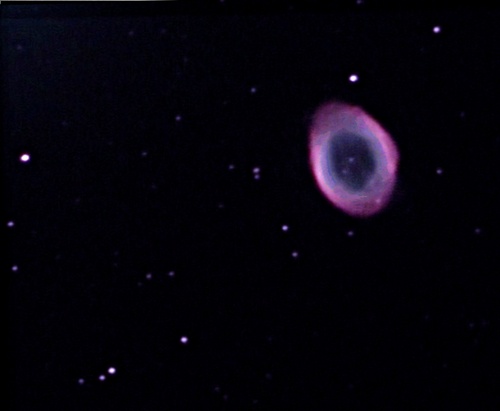
M57 with Mono and Colour Mintrons and an 11" SCT

I used a half inch chip Monochrome MTV-22S85HC-EX Mintron and a half inch chip OMEGA MTV-72S85H-EX-SW colour Mintron camera at the prime focus of an 11" f/10 SCT. The monochrome image was used as luminance and the colour image was used for chrominance and the two images were combined:
Monochrome Image:


Colour Image:


Combined Image:

The monochrome image captured fine whispy detail at the edges of the nebulae which is visible in the final combined colour image.
Image data and darkframe data were recorded at high quality to DVD. The BMP frames were then recovered from the DVD with no loss of quality using our VOB Frame Extractor software. The darkframes were scaled using our Dark Frame Scaler software. The aspect ratio of the final images was corrected to 4:3

Click on Older Posts to see more of this blog

Thursday, 8 April 2010

Solar Image with a 1/2" Chip Monochrome Mintron

A MTV-22S85HC-EX monochrome 1/2" chip Mintron camera was used with a x2 Barlow lens assembly and a H-alpha PST solar scope. Video was captured at shutter speeds to reveal the disk and also to reveal the prominences.
There were numbers of dark filaments as well as some prominences:

The two levels of exposure were combined and the image was colourised to indicate the colour of H-alpha light

Thursday, 1 April 2010

Saturn with an Omega 1/2 inch chip colour Mintron video camera

An unexpected clear spell between the clouds allowed an attempt at imaging Saturn.
An OMEGA 1/2" chip colour Mintron was used with a Skymax 127 with the lens assembly of a Skywatcher x2 Barlow (approx 1.5x) and a Revelation 2.5 Barlow produced this image from 2000 captured frames:


Steve Wainwright

Sunday, 21 March 2010

RGB images with a monochrome Mintron and a 6" f/5 achromatic refractor

A 6" F/5 Achromatic refractor was mounted on an EQ3-2 polar aligned mount. DVD was captured with red, green and blue filters at each of 256, 64 and 32 frame accumulations. The Mintron 22S85HC-EX 1/2" chip, frame-accumulating video camera also had stacked light pollution and UV/IR cut filters. Opticstar RGB filters and a manual filter wheel were used.

The different images for each colour channel and each level of frame accumulation were stacked in Registax. Then the colour channels were combined using Andrew Sprott's CAP (Colour Alignment Processor) to produce a colour image for each level of frame accumulation which was then processed for levels in the Gimp. Finally the three images for each level of frame accumulation were registered and combined in Andrew Sprott's FIC (Flexible Image Combine) to reveal all parts of the nebula. The Aspect ratio of the image was corrected in the Gimp and the final image was resized down a little.
M42/M43 RGB image

Dont forget to click on 'Older Posts' or 'Newer posts' below or browse the 'blog archive' on the left.

Friday, 5 March 2010

RGB Colour Imaging with a Monochrome Mintron

I had some help with our first experiments on RGB imaging with an MTV-22S85HC-EX monochrome 1/2" chip Mintron. Wayne Jones of the Swansea Astronomical Society used his 130mm F:900mm Newtonian on a driven equatorial mount. He used Red Green and Blue simple colour filters that are not designated for RGB imaging but which have good characteristics of filtering out the other colours.

The technique he used was to place the Mintron back in the focuser in exactly the same orientation after each filter change. This was essential because there was not enough in focus on the scope to use a filter wheel. He has devised an ingenious way of doing this.
AVIs were captured at different levels of frame accumulation for each filter. The unique frames were extracted from the AVIs using VOB Frame extractor which will work on AVI containers as well as DVD VOB files. The frames were stacked in Registax and the different 'exposures' registered and combined in Flexible Image Combine, which computes a weighted average of the frames used. The resulting monochrome images taken through Red Green and Blue filters were registered and combined into an RGB image in CAP (Colour Alignment Processor). The final image was adjusted for levels, colour balance and saturation in The Gimp image processor.

This is the result obtained by Wayne on March 4th; an RGB image of M42:

I used a Skymax 127 on an equatorial mount with a Kson manual filter wheel.

The Red and Green filters were Opticstar Imaging filters and the blue filter was a Kson filter, somewhat darker than the Opticstar one. With hindsite, maybe this was a mistake. 15 minutes of DVD were recorded with each filter and 10 minutes without a filter. However, for all of the video, a Skywatcher light pollution filter was on the nosepiece of the MTV-22S85HC-EX 1/2" chip monochrome Mintron.
The unique frames were extracted from the DVD VOB files and were stacked in Registax.
The resulting monochrome images were registered and combined as RGB colour layers in the CAP software. The final image was adjusted for levels, colour balance and saturation in The Gimp image processing software.

RGB image of the trapezium area of M42

This was the Luminance image

The RGB image produced above was registered and combined with the Luminance image in FIC (Flexible Image combine) weighted averaging software to produce the LRGB image below. The RGB image was given a weight of 6 with the Luminance image having a weight of 1.

LRGB image of the trapezium area of M42


Dont forget to click on 'Older Posts' or 'Newer posts' below, browse the 'blog archive' on the left, or click on 2009 or 2010 to see all of the posts for that year on one page.

Thursday, 7 January 2010

New 1/2" colour Deep-Sky Mintron for 2010

The new 1/2" chip colour Deep-Sky Mintron, the 72S85HP-EX-SW OMEGA has wider fileds of view, better colour fidelity and lower amp glow than the previous incredible 1/3" Helix version. This camera was launched at Astrofest.

M82 with the new 1/2" chip colour 72S85HP-EX-SW OMEGA Mintron with a 10" f/4.8 Newtonian

The Cat's eye Nebula with a 10" f/4.8 Newtonian and a x2 Barlow


The previous post in December 2009 gave the proving results for this camera.
Extracting unique Frames from DVD recordings
The Vob file extractor software as described in my December 2009 article in Astronomy Now can be freely downloaded here.
Dont forget to click on 'Older Posts' or 'Newer posts' below or browse the 'blog archive' on the left, or click on 2009 to see all of the posts for last year on one page.

Wednesday, 23 December 2009

Advances in colour Mintron deep-sky imaging

The Shape of things to come.

I am working on a new colour Mintron camera with Mintron Enterprise Co., Ltd. and have some preliminary results to show. This is the 72S85H-EX-SW-OMEGA colour 1/2" chip, deep-sky Super Wide field, low amp-glow Mintron frame-accumulating video camera..
I have tested this experimental camera with a variety of telescopes and present some results here:

M42/3 with an f/5 130mm Celestron Nextstar SLT Newtonian.


M42/3 with an f/5 Kson 80mm apochromatic refractor

In both cases the image was made by combining three images: one exposed for the outer, fainter nebulosity (256 frame accumulation), a second exposed to an intermediate level (64 frame accumulation) for the nebulosity immediately surrounding the central, trapezium area, and a third exposed for the central, bright, trapezium part of the nebula (8 frames accumulation).

M43 with an f/4.8 10" newtonian


The Flame nebula in Orion with an f/4.8 10" Newtonian


The Running Man nebula in Orion with an f/4.8 10" Newtonian


The blue reflection nebula has shown up quite well in the final image.


M1 The Crab nebula with a 10" f/4.8 Newtonian and a 0.5 focal reducer


M13 with a 10" f/4.8 Newtonian and a 0.5 focal reducer


M57 with a 10" f/4.8 Newtonian and a 0.5 focal reducer


M27 with a 10" f/4.8 Newtonian and a o.5 focal reducer


Telescope Planet Mintrons

Remember that a monochrome camera is always going to be much more sensitive than a colour camera.
To obtain satisfactory colour images you must have a fast scope, and the bigger the aperture the better.


Dont forget to click on 'Older Posts' or 'Newer posts' below or browse the 'blog archive' on the left, or click on 2009 to see all of the posts for this year on one page.

Thursday, 19 November 2009

Article in Astronomy Now on extracting images from DVD recordings without using a capture card and with no loss of quality

Advances in Deep Sky Video Astronomy

Ian Davies and I have published an article in the December 2009 issue of Astronomy Now magazine in which we show how to capture images directly from DVD recordings without the use of a capture card and with no loss of quality.

If, as I do, you record your
Mintron video stream to DVD for future viewing and subsequent image capture, then this article is for you.

All you need is a computer with a DVD drive and our new freeware software.


Full details including how to get the software are in the article. Enjoy !


It is a shame that Astronomy Now managed to get the last illustration in the article completely wrong. They credited my image to Ade Ashford, got the camera wrong; it was in fact an MTV-73S85HP-EX-SW-R colour deep-sky Helix Mintron, and the scope is clearly a refractor not a reflector. These things happen :-(

Now you can download the VOB extractor program. It is freeware.

The Sun seems to be finally waking up into Solar Cycle 24
Why not take a look at my eBook on 'Observing and Imaging the Sun with Modest Equipment'

Steve Wainwright

Thursday, 15 October 2009

A MTV-73S85HP-EX-SW-R colour deep-sky Helix Mintron and a 10" Newtonian

On a night of very good transparency and no Moon, the MTV-73S85HP-EX-SW-R colour deep-sky Helix Mintron was placed at the prime focus of a 10" Orion Europa Newtonian and trained on M27, the Dumbbell nebula.

Thirty minutes of video was recorded to DVD in High Quality and 282 frame were recovered directly from the DVD as .BMPs.

Deep Sky Stacker was used to register and stack the best 85% (239) images using a 75% scaled dark frame obtained from stacking 176 dark frames. This was the resulting image, rescaled to 640 x 480 before cropping and further post processing was performed in the Gimp

Adjustments were made to levels, colour balance and saturation to produce the final image.

A single frame gives some idea of what the live image on the TV monitor was like


Telescope Planet Mintrons

Dont forget to click on 'Older Posts' or 'Newer posts' below or browse the 'blog archive' on the left, or click on 2009 to see all of the posts for this year on one page.

Sunday, 27 September 2009

The MTV-73S85HP-EX-SW-R colour deep-sky Mintron and an f/4.8 10" Newtonian

An MTV-73S85HP-EX-SW-R colour deep-sky Helix Mintron with a 0.5 focal reducer and an IR cut filter was placed at the Prime focus of a 10" f/4.8 Newtonian.

The video stream was recorded in HQ on DVD. The frames were extracted dircetly from DVD and 281 frames were used (the best 90%) by Deep Sky Stacker to produce the image. A 75% scaled dark frame was used.

This is the image of Caldwell 27 (The Crescent Nebula) obtained.


Caldwell 33, (The Eastern Veil Nebula) was revealed nicely when the best 90% of 176 frames were stacked in Deep-Sky Stacker using a 75% scaled dark-frame.


This image of M82 was derived from the best 95% of 176 frames stacked in Deep Sky Stacker with a 75% scaled dark-frame subtraction.


This image of M13 was derived from 300 frames registered in Deep Sky Stacker and corrected with a scaled dark-frame


The colour balance and levels were adjusted in The Gimp.


Take a look at my eBook on Observing and Imaging the Sun with modest equipment


Dont forget to click on 'Older Posts' or 'Newer posts' below or browse the 'blog archive' on the left, or click on 2009 to see all of the posts for this year on one page.

Tuesday, 22 September 2009

An MTV-73S85HP-EX-SW-R colour deep-sky Mintron with a large, fast Newtonian

An MTV-73S85HP-EX-SW-R colour deep-sky Mintron was placed at the prime focus of a 10" f/4.8 Newtonian and the video stream was recorded on DVD.

30 minutes of recording produced a total of 354 unique frames that were extracted from the DVD and stacked with Deep Sky Stacker using a scaled darkframe (derived from stacking 127 frames in Registax).
The scaling could be more accurate, but that is for the future.
This is the resulting image of M57.

The final colour balance and processing was done in The Gimp.

An 0.5 focal reducer lens was placed on the camera and 51 unique frames were recorded to DVD before clouds stopped the session. The frames were stacked in Deep Sky Stacker using a scaled dark frame as above.
This is the resulting image of M27

Some coma was introduced by the reducer, but was not serious. The final colour balance and processing was done in The Gimp.
If you are interested in observing or imaging the Sun, take a look at my eBook on 'Observing and Imaging the Sun with Modest Equipment'.
Dont forget to click on 'Older Posts' or 'Newer posts' below or browse the 'blog archive' on the left, or click on 2009 to see all of the posts for this year on one page.

Sunday, 20 September 2009

An MTV-73S85HP-EX-SW-R colour deep-sky Mintron with a small, fast Newtonian

The MTV-73S85HP-EX-SW-R colour deep-sky Mintron was used at the prime focus of a Skywatcher 130P Synscan AZ GOTO telescope and DVD recordings were made of M13 and of dark-frames. The camera was set at 256 frame accumulation.
M13

176 image frames were extracted from the DVD recording. A dark frame was made in Registax from 127 dark frames extracted from the DVD recording. Deep-Sky Stacker was used to derotate the images, dark-frame correct them, register and stack them. The resulting image was processed in The Gimp to improve the colour balance and levels.

Dont forget to click on 'Older Posts' or 'Newer posts' below or browse the 'blog archive' on the left, or click on 2009 to see all of the posts for this year on one page.

If you are interested in the Sun, take a look at my eBook on observing and imaging the Sun with Modest equipment

Tuesday, 15 September 2009

Andromeda and Omega with a small fast Newtonian

Imaging with the MTV-22S85HC-EX monochrome 1/2" chip, deep-sky Super Wide field, low amp-glow Mintron

There was a wind blowing at my exposed, south-facing field site. I captured video to DVD and managed to get just 32 frames on 256 frame accumulation. Deep Sky Stacker produced the image below:

This image of M17 (the Swan or Omega Nebula) was taken when the Moon was below the horizon.

The scope used was a Skywatcher 130P Synscan AZ GO TO Newtonian
The dust lanes in M31 showed up nicely in this fast little scope.


Take a look at my eBook on Observing and Imaging the Sun with modest equipment


Dont forget to click on 'Older Posts' or 'Newer posts' below or browse the 'blog archive' on the left, or click on 2009 to see all of the posts for this year on one page.

Thursday, 10 September 2009

MTV-22S85HC-EX monochrome 1/2" chip, deep-sky Super Wide field, low amp-glow Mintron with a 10" f/4.8 Newtonian

The MTV-22S85HC-EX monochrome 1/2" chip, deep-sky Super Wide field, low amp-glow Mintron was fitted with a neodymium filter and placed at the prime (Newtonian) focus of the Telescope. Even with a rising Moon causing sky glow the Crescent Nebula was visible in the real-time image on the TV screen.
These images were extracted from high quality DVD recordings
Cald 27, The Crescent Nebula
Cald 33, Part of the Eastern Veil Nebula
Take a look at my eBook on Observing and Imaging the Sun with Modest Equipment

Dont forget to click on 'Older Posts' or 'Newer posts' below or browse the 'blog archive' on the left, or click on 2009 to see all of the posts for this year on one page.

Sunday, 30 August 2009

The new Mintron 22S85HC-EX 1/2" chip, frame-accumulating Mintron video camera. and more

The Mintron 22S85HC-EX 1/2" chip, frame-accumulating monochrome video camera was featured here two posts ago. It has a 1/2" CCD chip which gives slightly wider fields of view than the 1/3" chip model, the MTV-23S85HC-EX-R. Moreover it has very low amp-glow which is an advantage when the camera is being used as an observation tool.
I am adopting the term 'frame-accumulation' rather than 'frame-integration' as there is some ambiguity in what is meant by 'integration' in this sense.
This post gives a preview of advances in astrovideography that will lead to better quality images and will obviate the need for a computer capture card as long as a DVD recorder is available, or will allow a computer with a capture card to record DVD from which images can be recovered without quality loss.

I have, with Ian Davies, written an article which should appear shortly in 'Astronomy Now' that explains everything. It will also explain how to obtain the freeware software that Ian has developed to acheive this.

In the meantime, here are some results produced with a Celestron C6 and a The Mintron 22S85HC-EX 1/2" chip, frame-accumulating video camera.

The Cat's Eye Nebula, Caldwell 6 using a x2 Barlow


M13 using a 6.3 focal reducer/field flattener


M17, The Swan or Omega nebula (Captured under a full Moon) at the prime focus of a Skywatcher 130P Synscan AZ GOTO Newtonian.

These images were extracted directly from a DVD recording without a capture card and without associated losses in quality.
Watch this space:

Check out my eBook on Observing and Imaging the Sun with Modest equipment, with a foreword by Sir Patrick Moore.

Dont forget to click on 'Older Posts' or 'Newer posts' below or browse the 'blog archive' on the left.