Thursday, 30 August 2018

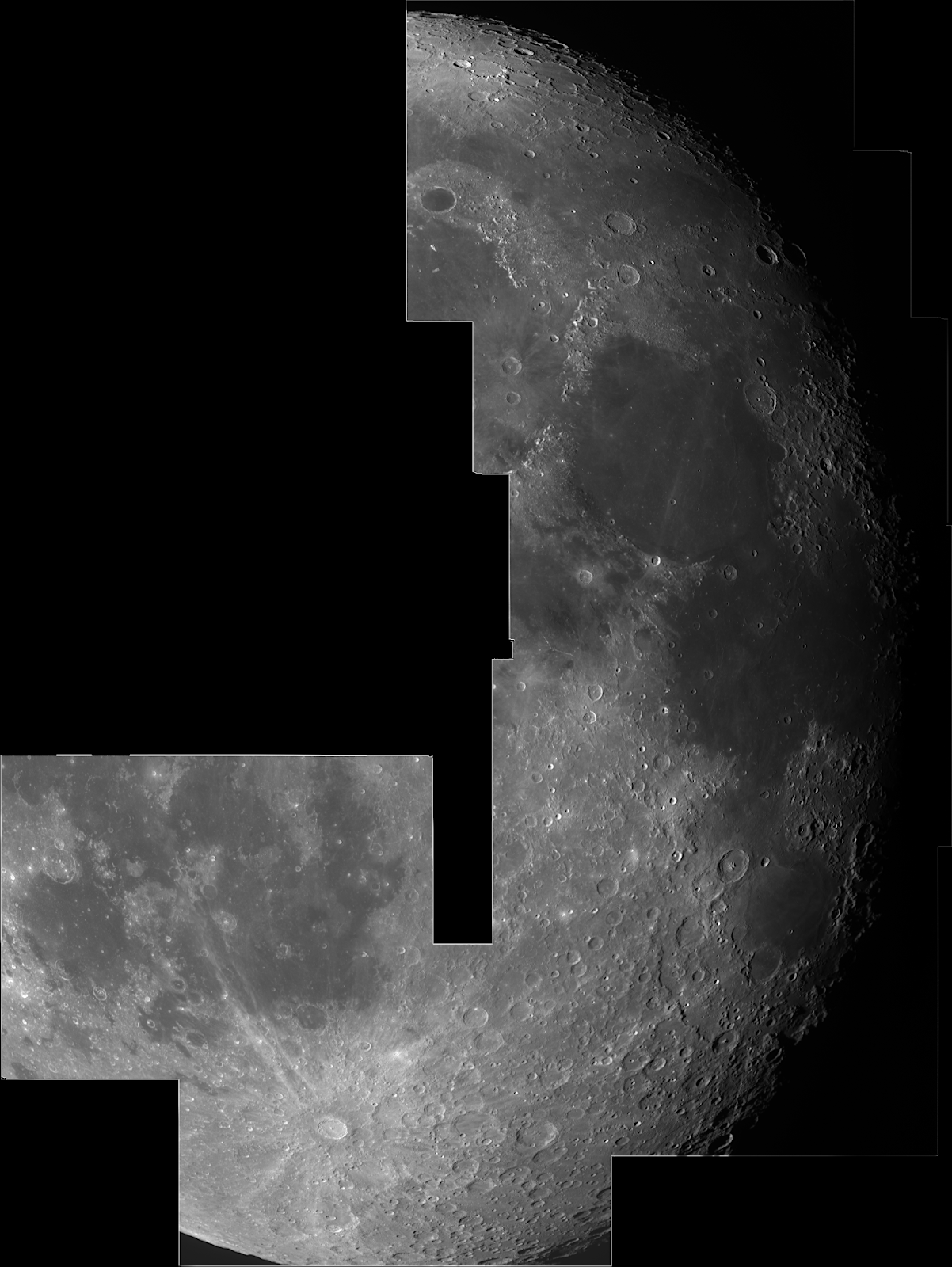
High resolution 88% waning Moon images with AstroDMx Capture for Linux and a DMK 37AUX273 camera

A Skymax 127 Maksutov was mounted on a Celestron AVX, EQ, GOTO mount. An Imaging Source DMK 37AUX271 machine vision camera was placed at the prime focus. AstroDMx Capture for Linux was used to capture 8 overlapping, 2000 frame SER files of the 88% waning, gibbous Moon in High contrast and terminator areas, as well as the Copernicus/Kepler region.
(All running in Wine), Autostakkert! 3.10 was used to stack the best 80% of the SER file frames, Microsoft ICE was used to stitch the resulting images together and Registax 5.1 was used to wavelet process the resulting Mosaic. The resulting high resolution mosaic was post processed in the Gimp 2.10.
The scope was protected from the intrusive light from a nearby garden lamp by means of an occultation board which cast a shadow across the scope.
Occultation board


Copernicus and Kepler

Full size

High resolution Mosaic

Closer view


Full size pane of the Aristotelese, Eudoxus, Lacus Mortis, Hercules, Atlas, Posidonius region


Full size pane of the Theophilus, Cyrillus, Catharina, Fracastorius, Mare nectaris, Piccolomini region

Full size pane of the Tycho region


The DMK 37AUX273 can be considered to be an excellent Lunar and Solar imaging device. Seeing was too poor to gather worthwhile planetary images as Mars and Saturn were far too low in the sky. However, a test showed that high frame rates could be achieved capturing monochrome planetary data through this modest 5" Maksutov. Larger, planetary imaging scopes would cope even better.

Saturday, 25 August 2018

H-alpha Sun with a DMK 37AUX273 and AstroDMx Capture for Linux

A DMK 37AUX273 camera was mounted at the prime focus of a Solarmax ll, 60, BF15 H-alpha scope, mounted on an iOptron Cube Pro, AZ GOTO mount.


AstroDMx Capture for Linux was used to capture two overlapping 1000 frame 8 bit SER files, which were Stacked in Autostakkert! 3.1, stitched in Microsoft ICE and wavelet processed in Registax 5.1, all running in Wine. The final image was post processed and colourised in the Gimp 2.10.


The Sun in H-alpha light


Active regions 2719 and 2720 are clearly visible as is a large filament.

Full size


The camera had sufficient dynamic range to be able to capture both disk and prominence details. The stitched image was duplicated and one image processed for the disk and the other processed for the prominences. The two images were then combined in the Gimp 2.1 to give the image presented here.

It is clear that this is a good camera for H-alpha solar imaging and was able to deliver over 60 fps whilst imaging at maximum resolution.

Friday, 24 August 2018

94% waxing Moon and the Ring nebula with AstroDMx Capture for Linux and a ZWO ASI178MC 14 bit camera

We are on the home straight towards the next release of AstroDMx Capture for Linux. These images were produced as part of the pre-release testing program.
The  ZWO ASI178MC is a camera with a 14 bit ADC and a back illuminated 6.4 MP Sony IMX178 CMOS sensor with 7.4 x 5 micro metre pixels which use STARVIS and EXMOR R technologies.

These technologies produce higher sensitivity and lower noise as well as reducing rolling shutter distortion. The back illumination avoids the internal circuitry in the sensor obstructing some of the light falling on the sensor before it reaches the photodiode. This allows for the reduction in size of the pixels and higher pixel counts on the sensor without increasingly the proportion of the light that is attenuated before it reaches the photodiode. The global shutter reset reduces the rolling shutter distortions that can occur if the subject moves (In astronomical imaging, the only movement should be due to seeing. However, some people image while the object drifts across the field of view or manually nudge the scope to keep the object in the field of view).

This test was done on a night with a low, 94% waxing Moon in the sky. This produced relatively poor seeing and a sky filled with Moon glow.

The ZWO ASI178MC camera was placed at the Newtonian focus of a Skywatcher, f/5, 130PDS Newtonian mounted on a Celestron AVX EQ, GOTO mount. Two overlapping 500 frame SER files were captured at full resolution (3096 x 2080). The best 95% of the frames were stacked in Autostakkert! 3.1 running in Wine. The resulting images were wavelet processed in Registax 5.1, and stitched into a single image using Microsoft ICE, both running in Wine. The final image was post processed in the Gimp 2.10.


Deep sky on a moonlit night

The ZWO ASI178 has a 14 bit ADC unlike many of the CMOS astronomical cameras which have 12 bit ADCs. This means that it can capture images with 16384 levels of brightness, compared with a 12 bit ADC which produces 4096 levels of brightness.
AstroDMx Capture for Linux saves the 14 bit data, mapped to the lower or the upper bits of a 16 bit container. This is still not up to the 16 bit ADCs of traditional CCD based astronomical cameras, but it is a substantial improvement on 12 bit devices.

With the bright Moon illuminating the sky, the ZWO ASI178MC in the same configuration was used to capture 40 x 40s exposures of the Ring nebula.

Screenshot of AstroDMx Capture for Linux capturing images of M57.

The display was using Gammalog, but could be changed to show more contrast if required, but as all that is usually required is to correctly position the object of interest, no further adjustments were made. It should be remembered that the display controls are non destructive, so do not affect the data being captured.

The best 90% of the images were stacked in Deep Sky Stacker running in Wine, and post processed in the Gimp 2.10.


Performance and real-time display are still being improved, but a release will not be far away.

Saturday, 18 August 2018

More about the soon to be released version of AstroDMx Capture for Linux


The next release of AstroDMx Capture for Linux will support the following cameras and run on the following Linux distros.

List of cameras implemented for AstroDMx Capture for Linux
USB Astronomy Cameras
DMK 21AU04.AS (CCD,USB2.0, 8 bit ADC)
DMK 37AUX273 (CMOS, USB3.0, 12 bit ADC)
DFK 21AU04.AS (CCD, USB2.0,8 bit ADC)
DBK 21AU04.AS (CCD,USB2.0, 8 bit ADC)
ZWO ASI120MC (CMOS, USB2.0, 12 bit ADC)
ZWO ASI120MC-S (CMOS, USB3.0, 12 bit ADC)
ZWO ASI120MM-S (CMOS, USB3.0, 12 bit ADC)
ZWO ASI178MC (CMOS, USB3.0, 14 bit ADC)
SVBONY T7 W2568A (CMOS, USB2.0, 12 bit ADC)
QHY 5M-IIM (CMOS, USB2.0, 12 bit ADC)
QHY 5M-IIC (CMOS, USB2.0, 12 bit ADC)
Bresser MicrOcular Full HD Digital Camera (CMOS, USB2.0, 8 bit ADC) (Motion-JPEG only)
SVBONY SV105 Full HD Digital Camera (CMOS, USB2.0, 8 bit ADC), (Motion-JPEG only)
Atik 314L mono (CCD, USB2.0, 16 bit ADC)
Atik 320E colour (CCD, USB2.0, 16 bit ADC)
USB cameras
ELP-USB130W01MT-SFV HD camera (CMOS, USB2.0,8 bit ADC)
ELP 1.3Mp CMOS board-level HD camera (CMOS, USB2.0, 8 bit ADC)
Lucky Zoom 5Mp microscope camera (CMOS, USB2.0, 8 bit ADC)
Vimicro PC camera (e.g. Maplin USB2.0 Microscope) (CMOS, USB2.0, 8 bit ADC)
USB Capture cards
KWORLD DVD MAKER 2 (8 bit ADC)
UVC capture card (8 bit ADC),(Motion-JPEG only)
EasyCAP (8 bit ADC) (Motion-JPEG only)
USB webcams
Sweex WC066 HD webcam (CMOS, USB2.0, 8 bit ADC)
Sweex WC070 ViewPlus (CMOS, USB2.0, 8 bit ADC)
Philips SPC900NC including SPC800 and Philips 740 flashed to SPC900NC (CCD, USB2.0, 8 bit ADC)
Philips 740 ToUCam Pro (mono feed only) map YUYV to greyscale for true mono. (CCD, USB2.0, 8 bit ADC)
Philips 690 Vesta Pro Webcam (CCD, USB2.0, 8 bit ADC)
Logitech HD C525 (CMOS, USB2.0, 8 bit ADC)
Microsoft LIFE-CAM 2 (CMOS, USB2.0, 8 bit ADC)
Creative Webcam Live (CMOS, USB2.0, 8 bit ADC) Bayer output only.
Creative Webcam Live (CMOS, USB2.0, 8 bit ADC) JFIF/JPEG output only.
All Video 4 Linux, UVC cameras.

List of Linux Operating systems and desktop environments tested to date with AstroDMx Capture for Linux
Debian 9, xfce, LXDE, Cinnamon, GNOME 3, MATE, Plasma
Fedora 24, 25, 26 Gnome 3
Fedora 26, 27, Cinnamon
Fedora 28, xfce, Cinnamon, Gnome 3 
Linux Mint 18.2 Cinnamon, MATE, xfce
Kubuntu 16.04 LTS
Kubuntu 17.04
Xubuntu 17.04
Lubuntu 17.04
Ubuntu Gnome, Gnome 3 or classic
Ubuntu 16.04 with Unity (with the additional download package)
Ubuntu 17.04 with Unity (with the additional download package)
Peppermint OS
Antergos Linux
PC Linux Mate
Mageia Linux
Elementary OS. Runs from the command line only at the moment


Nicola has already implemented these cameras and a release is imminent. She is just finalising the improved display of 16 bit images as they are being captured and checking for memory leaks.

Shortly after this release it is intended to release a version for the Raspberry Pi. This needs a little more work and so is unlikely to be released simultaneously.

The current release and all subsequent releases can be downloaded here:    http://www.linux-astro-imaging.uk/

The latest version will be released very soon.

As this is not a full time enterprise and generates no funds, delays are inevitable. The aim is to keep the software as stable as possible, so, as testing reveals issues, they are systematically solved. Sometimes this takes more time than anticipated. 

Nicola works on DMxCapture for Linux most days. The program is now huge and contains more than 30,000 lines of active code (many of which extend over a number of physical lines) and more than 7000 additional lines of internal documentation comments, and this excludes all dependencies. 

To put this in perspective, if the source code was to be printed in a typical book, the book would run to many more than 1000 pages in length. That is a lot of code to maintain, test and extend.

Saturday, 11 August 2018

Testing the new DMK 37AUX273 USB3.1 Machine-vision camera in AstroDMx Capture for Linux


Following an invitation to make proposals to The Imaging Source to test their new cameras, we have received a DMK 37AUX273 that we selected because it has a number of possible desirable characteristics for astronomical imaging:

Dynamic range 8/12 bit
Video output format 8-Bit Monochrome, 16-Bit Monochrome

Sensor type: CMOS Pregius
Sensor: Sony IMX273LLR
Shutter global
Format 1 / 2.9
Resolution 1,440×1,080 (1.6 MP)
or 640 x 48 ROI
Frame rate 270 fps
Pixel size H: 3.45 μm, V: 3.45 μm
Lens mount C/CS

The DMK 37AUX273 USB3.1 is a very diminutive camera compared with the familiar DMK 21AU04 AS camera. Its dimensions are 36×36×25 mm not including the nosepiece. It currently retails at 286.8 Euro including VAT.


The initial tests were with AstroDMx Capture for Linux before 16 bit output and ROI are implemented for this camera.

Solar and Lunar imaging

DMK 37AUX273 attached to a SolarMax ll 60 BF15 H-alpha scope


The first test was on the Sun using a Coronado Solarmax ll, 60, BF15 H-alpha scope. Two overlapping, 2000 frame SER files were captured at prime focus with AstroDMx Capture for Linux, exposed for the disk and two more exposed for the prominences. The best 80% of the frames were stacked in Autostakkert! 3 and stitched in Microsoft ICE, and wavelet processed in Registax 5.1 all running in Wine. The overexposed prominence images were stitched in Jon Grove’s iMerge running in Wine. The images were post processed and combined in the Gimp 2.10.


Full Size


Another test involved using a 2x Barlow lens screwed on the front of the nosepiece and imaging a region with a prominence. With this arrangement no Newton’s rings could be seen, but they were present if the Barlow lens was mounted normally in the Barlow housing. A 2500 frame SER file was captured exposed for the disk and a second SER file was captured exposed for the prominence. The SER files were stacked and wavelet processed in Registax 5.1 running in Wine. The two images were combined and post processed in the Gimp 2.10.


The camera showed good dynamic range in these experiments.

The best 80% of frames captured of the Palus Somni region of the waxing, crescent Moon were stacked in Autostakkert!3 and wavelet processed in Registax 5.1, both running in Wine. The image was post processed in the Gimp 2.10.


There is no doubt that for lunar and solar imaging, this camera performs well.

Deep sky imaging.

The DMK 37AUX273 was placed at the Newtonian focus of a Skywatcher Explorer 130 PDS 130mm, f/5 Newtonian mounted on a Celestron AVX EQ, GOTO mount.
The DMK 37AUX273 camera had not yet been implemented in AstroDMx Capture for Linux, so the deep-sky imaging had to be done in 8 bits. The software was set up to integrate 10 x 2s, 8 bit exposures into a 16 bit Tiff file. 50 such files were captured of the Swan nebula. 10 matching, 16 bit dark frames were captured. The images were stacked in Deep Sky Stacker running in Wine and the final image processed in the Gimp 2.10

Screenshot of AstroDMx Capture for Linux


The Swan nebula


The eagle nebula was imaged using integrations of 10 x 6s exposures. 15 such exposures were captured along with 5 matching dark frames. The images were stacked in Deep Sky Stacker running in Wine. The resulting image was post processed and cropped in the Gimp 2.10 to show the Pillars of Creation.

The Pillars of Creation in the Eagle nebula


So, first impressions of the camera using AstroDMx Capture for Linux that had not yet had the camera implemented for 16 bits and ROI, are favourable. However, until the camera is fully implemented, no more information is available.

After 16 bit capture was implemented, A stack of 45, 30s exposures yielded the following image which is cropped from the middle of the frame to avoid currently intractable amp glow regions.

ROI has now been implemented.

Wednesday, 8 August 2018

A replacement nosepiece for the SVBONY SV105 low cost camera

SVBONY have released a replacement nosepiece with filter threads for the SV105 low cost astronomy camera. This is one of the suggestions that I made to the company about this low cost, well built, USB astronomy camera. The camera is too sensitive to use with a fast scope on a bright object such as the Moon. If an extender tube was used to attach a neutral density filter, it became impossible to bring the camera to focus on some scopes due to lack of back focus. This simple solution allows a ND filter to be attached directly to the nosepiece, so that focus can be achieved.

Replacement nosepiece
The old nosepiece simply unscrews without disturbing the IR cut filter, and the replacement nosepiece screws into place. There is thus, no danger of introducing dirt onto the sensor during the process.

Replacement nosepiece in place
The filter threads can be seen.

A Double polarising filter is attached to the nosepiece in this instance, to allow exactly the right attenuation to be achieved for optimal exposure and frame rate.

The SV105 with a double polarising filter attached.


This is a significant improvement to the camera.
It should be remembered that for best results, flat fields should be employed to correct for pixel vignetting.

Monday, 6 August 2018

AstroDMx Capture for Linux and the Raspberry Pi 3

In May 2017 I wrote here about using AstroDMx Capture for Linux to capture long exposure images with the Raspberry Pi 
However, Nicola did not make a release as she was busy implementing more cameras in the 64 bit RPM and DEB versions of the software.
Nicola has now been working again on a 32 bit version of AstroDMx Capture for Linux for the Raspberry Pi 3 running the latest Rasbian with Desktop (Based on Debian), but this time, implementing all of the cameras implemented in the 64 bit version. It is her hope to release both versions very soon, after a small number of known bugs are fixed and a new way of visualising the incoming data from a 16 bit (or 12 bit data in a 16 bit container) has been completed.
The Raspberry Pi version was tested using two cameras; the QHY 5M-II-C 12 bit colour camera and the Atik 314L 16 bit mono camera. At this stage, the data were transferred to another computer for processing, although subsequent experiment will be done to determine how much can be done on the Pi itself.
QHY 5M-II-C testing with the Raspberry Pi 3
A Celestron Nextstar 8 OTA was mounted on a Celestron AVX EQ, GOTO mount. A QHY 5M-II-C camera fitted with a 2x Barlow was used to capture a 1500 frame SER file of Saturn.

The Raspberry Pi capturing data on Saturn with AstroDMx Capture for Linux

The best 80% of the frames were stacked in Autostakkert! 3 running in Wine and wavelet processed in Registax 5.1 also running in Wine. The image was post processed in the Gimp 2.10 and Neat Image.
Saturn with the QHY 5M-II-C and AstroDMx Capture for Linux

The QHY 5M-II-C was kindly loaned by Derek Francis of the Swansea Astronomical Society to help with the development of the software.
Atik 314L testing with the Raspberry Pi 3
A Skywatcher Explorer 130 PDS 130mm, f/5 Newtonian was mounted on a Celestron AVX EQ, GOTO mount. An Atik 314L mono camera fitted with a narrowband H-alpha filter was placed at the Newtonian focus and AstroDMx Capture for Linux was used to capture 50 x 60s exposures of M16, the Eagle nebula with the Pillars of creation. 10 matching darkframes were also captured. The best 90% of the frames were registered and stacked in Deep Sky Stacker running in Wine and the resulting  FITs image was processed in ESO, ESA, NASAs Fits Liberator software running in Wine and FastStone image viewer running in Wine.

M16 H-alpha data on M16 being captured by the Paspberry Pi 3 and AstroDMx Capture for Linux

Closeup of the screen showing the real time display of the captured data

Final image of M16 in H-alpha light


Full size


The new versions of AstroDMx Capture for Linux will soon be released, including the version for the Raspberry Pi 3.
One thing that is abundantly clear is that the Raspberry Pi 3 is a viable astro-imaging device.
Watch this space for further developments and more news on releases.

Wednesday, 1 August 2018

Two Atik cameras implemented in AstroDMx Capture for Linux


Nicola has finished implementing the Atik 314 L monochrome camera in AstroDMx Capture for Linux, and thanks to Anne Startup of the Swansea Astronomical Society who lent us an Atik 320E colour camera, the 320E is now also implemented.

A new release of AstroDMx Capture for Linux is now very close.
It is likely that a version compiled for the Raspberry Pi 3 will also be released at around the same time.

At this point it is appropriate to thank those individuals and organisations who have made cameras available to us for implementation in AstroDMx Capture for Linux.
Our thanks to the following:

Anne Startup; Atik 320E
Derek Francis; QHY 5M-II-C and ZWO ASI120MM-S
Colin Miles; ZWO ASI120MC-S
Telescope House; Bresser MicrOcular Full HD Digital Camera
ZWBONY; SV105 and T7 W2568A

Monday, 16 July 2018

Slight delay in the release of the next version of AstroDMx Capture for Linux


Nicola is making great progress with the implementation of the Atik 314L in AstroDMx Capture for Linux as previous posts have shown. However, she has also been trying to resolve a problem over the QHY cameras giving unreliable exposures at certain long exposures. This is a problem with the QHY SDK.

The problems have been reported and new SDKs have been released. However, with each new SDK release, a number of other serious, deal-breaker problems have been introduced. These in turn are being reported, and the hope is that the QHY SDK developers will soon resolve all of the problems. In the meantime, it may be necessary to produce a release of AstroDMx Capture for Linux that implements the Atik 314L (and possibly others) before the QHY issues are resolved.

This is unfortunate and disappointing, but it is important to realise that the problem is not with the AstroDMx Capture code, but rather, with the SDK that has to be used to call the camera functions.

I will make sure that when a new release is made, the information will be posted here. Nicola will implement a hack that should improve the exposure situation for the QHY, but that is no substitute for a reliable SDK.

Sunday, 15 July 2018

Testing a new display function in AstroDMx Capture for Linux with an Atik 314L camera

An Atik 314L camera was placed at the Newtonian focus of a Skywatcher 130 PDS 130mm, f/5 Newtonian, mounted on a Celestron AVX GOTO mount. 16 x 48s exposures were captured of M8, the Lagoon nebula and 5 matching dark-frames using AstroDMx Capture for Linux. The images were dark-frame corrected and stacked in Deep Sky Stacker running in Wine. The final image was processed in Fits Liberator, running in Wine and the Gimp 2.10.

The problem with 16 bit imaging is that the image being captured has to be rendered in 8 bits so that it can be viewed on the computer screen. Moreover, the interesting parts of the data are very dim and with a simple scaling of the results to 8 bits, much of the object being image will probably be invisible. What is needed are transfer functions that will brighten, in a non-linear fashion, the image data, so that the fainter parts of the object are revealed. These transformations are only made to the displayed image, leaving the saved data untouched. AstroDMx Capture for Linux has been given a number of controls to optimise the visualisation of the data being captured. Here we were testing a gammalog display function to help reveal the object whilst being captured.

Final image of M8, the Lagoon Nebula


The images were captured while testing the new gammalog image display function in AstroDMx Capture for Linux.
Sreenshot

The preview image can be brightened or dimmed using the other non-destructive controls of gamma, brightness and contrast.
Additional display transformation functions are being implemented now and will be tested as soon as possible.

Tuesday, 10 July 2018

Occultation disks and streetlights

To the astronomical imager, streetlights can be such a problem as to make imaging all but impossible. I don't mean the general problem of light pollution in the sky caused by streetlights, I mean the glare from nearby streetlights that can shine directly into the telescope and ruin any results.
We have a streetlight right outside the front of the house. The council fitted internal baffles to the lamp on request, which reduced it in brightness a little, but it is still able to cast its bean of light onto our scopes that we have to use at the front of the house in order to image objects lower in the sky. This problem is solved by mounting a blackened occultation board on a sturdy tripod and placing it so that it casts its shadow onto the scope. This solution works very well and occultation disks or boards can help problems with more distant street lights that are in the general direction of where the scope is to be pointed.

The streetlight can be seen very close beyond the occultation board.


From the point of view of the scope, the street light is completely obscured and does not cause a problem.
Smaller occultation boards, strategicall placed, can deal with problems caused by more distant lights.

Saturday, 7 July 2018

First Light for the Atik 314L implementation in AstroDMx Capture for Linux

An Atik 314L camera was placed at the Newtonian focus of a Skywatcher 130PDS, 130mm, f/5 Newtonian, mounted on a Celestron AVX, EQ, GOTO mount. 16 bit Fits images were captured of  M16 (40s), M17 (40s) and M13 (35s) using AstroDMx Capture for Linux. For each object, the best 26 frames were stacked in Deep Sky Stacker, running in Wine. The images were post-processed in Fitswork (running in Wine), The Gimp 2.10, RawTherapee and Neat Image.

M16 the Eagle nebula and cluster

The Pillars of Creation

M17, the Swan or Omega nebula

M13

 Nicola hasn't quite finished the Atik 314L implementation. When it is finished, it will be present in the next release; which has been delayed by problems with the latest QHY SDK. QHY have been made aware of the problem and are currently working on it. In the meantime, the Atik 314L implementation goes ahead.

Tuesday, 19 June 2018

Adjusting the azimuth clutch on a Skywatcher Star Discovery mount.

Unlike the Synscan AZ, GOTO mounts, the Star Discovery Mount has FreedomFind™ dual encoder technology. This allows the mount to be pushed manually in either axis during use, and the controller keeps track of where the mount is pointing. The altitude axis has a sturdy clutch release and adjuster. However, the azimuth axis does not. With use, it is commonly found that the azimuth clutch becomes slack and the mount can be turned manually too easily. Even a gust of wind might be able to turn the scope on the azimuth axis.

Four screws hold the plastic top on the mount. When this is removed the double clutch assembly is exposed. The bottom clutch controls how difficult it is to manually turn the azimuth axis.

A spanner was made by hammering and filing a tool that came with a self assembly item, until it was wide enough to slide onto the flats on the bottom clutch. There are two Allen-key grub-screws between the flats opposite each other and these are slackened off with an Allen key. The clutch is then turned a very tiny amount clockwise and the grub screws tightened.
It is clearly a matter of trial and error to get the adjustment right, but this procedure works. It is best to turn the clutch by an almost imperceptible amount at one go. If it is overtightened, then the mount will stall while slewing in certain directions due to some asymmetry within the system.

Manufactured spanner and Allen-Key


The spanner engaging the flats

One of the retaining grub-screws is visible
I don’t know whether this procedure will invalidate the warranty, but I found that without doing it, the mount was virtually unusable. Nowhere in the manual is it explained how to correct this problem.

I use this mount as a substantial, quick setup, AZ GOTO mount for Solar system and deep sky observing and imaging. Previous postings on this blog show the mount in action. Of course there is image rotation, but as long as there is no perceptible rotation within images, then Deep Sky Stacker and lxnstack for example, are able to de-rotate the images during stacking. Keeping the azimuth clutch adjusted correctly is going to be critical for the continued use of this mount.

Monday, 11 June 2018

M17 with AstroDMx Capture for Linux and a QHY 5L-II-M

An f/5, Skywatcher Explorer 130 P-DS Newtonian Was mounted on a Celestron AVX, EQ, GOTO mount. A QHY 5L-II-M camera was placed at the Newtonian focus and AstroDMx Capture for Linux was used to capture 40 x 25s exposures of M17, the Omega or Swan Nebula as Tiff files. Matching dark-frames were captured. The frames were stacked in Deep Sky Stacker running in wine and the resulting Fits file was processed in the ESO, ESA, NASA FITS Liberator 3 software running in Wine. The resulting Tiff file was processed in Neat Image V8 and RawTherapee.

FITS Liberator
FITS Liberator is a very good program for non-linear stretching of Fits Images

M17

Full Size