Saturday, 6 May 2023

AstroDMx Capture with local plate solving and plate solving in the Cloud; and a procedural shift in the way that objects might be acquired and centred in the field of view.


Plate solving or Astrometric calibration of an image was done before modern times by the careful measurement of photograph glass plates of star-fields; now, of course it is done by computer software. Nicola has implemented in AstroDMx Capture, two methods of plate solving the field of view in order to determine how to automatically move the mount so that the required object is placed in the centre of the field of view.

The first method is a local plate solving solution using ASTAP and the second method, which requires an internet connection, does the plate solving in the cloud using Astrometry.net.

Sometimes, particularly if the field of view is quite small, a local plate solver can struggle to find a solution, although this can often be resolved by increasing the exposure. If the local plate solver fails to find a solution and the user has an internet connection, the plate solving can be done in the cloud by Astrometry.net, which is more likely to be successful. AstroDMx Capture makes the plate solving transparent to the user who only has to select the method to be used. In the experiments done here with a Skymax 127 Maksutov, a local plate solver may struggle due to the accuracy of the field of view and focal length, which varies with a Maksutov in which focusing is achieved by moving the primary mirror. This is no problem for Astrometry.net plate solving in the cloud.

We did experiments including a slightly different approach that facilitates working with lunar and planetary imaging in addition to deep sky imaging.

An SV605CC 14 bit CMOS camera was mounted at the focus of the Skymax 127 Maksutov telescope and an SV305 CMOS camera was mounted at the focus of an F=190mm, 50mm guidescope. Two instances of AstroDMx Capture were run on separate virtual desktops of a Fedora Linux computer. One instance streamed data from the Skymax 127 and the other streamed data from the guidescope. AstroDMx Capture was used to send the mount/scopes to the Moon.

The imaging scope and the guidescope were co-aligned so that the moon appeared in approximately the same place in the field of view of each scope.

Screenshot showing the imaging scope data stream at the top left and the guide-scope data stream at the top right.


Whilst on the Moon, AstroDMx Capture was used to capture three overlapping fields of view to cover the whole of the visible Moon. 1000-frame SER files were captured.


The best 95% of the frames in each SER file were stacked in Autostakkert running in Wine and the resulting images were combined into a single image using Photopad running in Wine.

Photopad is a useful alternative to Hugin or Microsoft ICE and works with relatively small amounts of vertical displacement and if the images are arranged correctly horizontally.

Mosaic Lunar image in Photopad

The mosaic image was wavelet processed by Registax 5.1 running in Wine and post-processed in the Gimp 2.10. Alternative wavelet processors such as waveSharp or IRIS could have been used.

85% waxing, gibbous Moon


Having imaged the Moon, attention then changed to deep sky imaging despite the bright moonlight.

AstroDMx Capture sent the mount/scopes to Regulus and Regulus was nudged to the centre of the field of view of the Maksutov imaging scope.


Regulus was focused in the guide-scope using a Bahtinov mask.

Well focused stars would produce optimal stars for PHD2 auto-guiding.

Using the guide-scope adjustment rings, Regulus was brought to the centre of the field of view of the guide-scope

Contrary to usual practice, Plate solving was done on the guide scope image using Cloud plate solving to refine the position of Regulus.

This just showed that it could be done if there were too few stars in the Imaging scope field of view.

From here on, in this session, all plate solving was done in the cloud on the imaging scope field of view.

When using a scope with such a long focal length and small field of view, it is best to start autoguiding for plate solving and only turn guiding off briefly during slewing. Nicola plans to implement PHD2 control within AstroDMx Capture to automate stopping and starting of the guiding routines when slewing is required.

Screenshot of PHD2 auto-guiding during this session.

AstroDMx Capture sent the scope/mount to M13, plate solved in the cloud and centred M13 in the field of view. (M13 can also be seen in the centre of the field of view of the guide scope in the above image). 

Screenshot of AstroDMx Capture capturing 32 x 2 minute FITS images of M13

Matching dark frames were also captured.

The best 50 minutes worth of data were calibrated with dark frames and flat fields and partly processed in Siril and post-processed in the Gimp 2.10, Fitswork and Neat Image.

M13


AstroDMx Capture was used to send the Scope/mount to M63 the Sunflower galaxy, plate solve in the cloud and centre the object in the field of view.

AstroDMx Capture capturing 3 minute FITS exposures of the Sunflower galaxy

Only 15 minutes worth of exposures were captured before clouds prevented further imaging.

Matching dark frames were also captured. The data were calibrated and stacked and partly processed in Siril and post processed in the Gimp 2.10, Fitswork and Neat Image.

The Sunflower galaxy M63
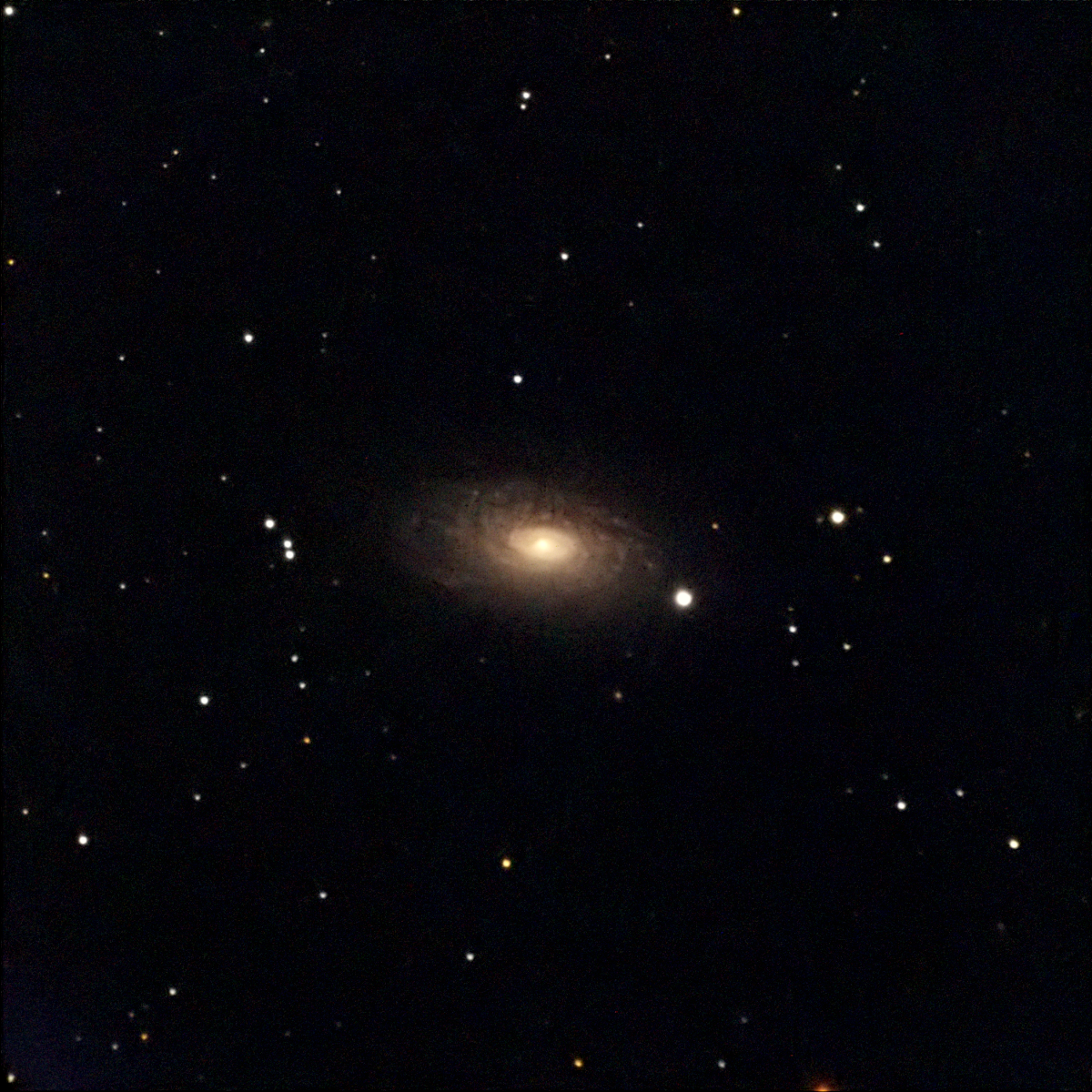
It is regrettable that more data could not be collected on this object at the time; but this image serves the purpose of demonstrating the imaging capabilities of the Skymax 127 in conjunction with an SV605CC camera.

This session succeeded in all of its aims:

  • To co-align accurately the Skymax 127 and the guide scope.
  • To position the Moon in the imaging scope with the aid of a second instance of AstroDMx Capture running on a different virtual desktop.
  • To capture lunar SER files and to process them in various software into a single mosaic image, and point out alternative software that could be used.
  • To demonstrate AstroDMx Capture plate solving in the cloud with Astrometry.net in a new GUI that is identical for the local ASTAP plate solver.
  • To plate solve in the cloud using the guide scope image stream as well as plate solving in the cloud with the imaging scope and camera.
  • To auto-guide the Skymax 127 using PHD2 and to capture image data on two deep sky objects.

The control of PHD2 by AstroDMx Capture for the purpose of automatically turning off guiding during slewing and turning it back on after slewing completes was recognised as a requirement for implementation, and Nicola will be implementing it for a future release of AstroDMx Capture.

The cloud plate solving will be present in the next release of AstroDMx Capture which Nicola will make soon, and instructions on how to set it up will be provided.

AstroDMx Capture for all operating systems can be downloaded HERE.


Monday, 1 May 2023

Lunar imaging with a SV605CC OSC CMOS camera, a Skymax 127 Maksutov and AstroDMx Capture

The SV605CC OSC CMOS camera fitted with a UV/IR cut filter was used with a Skymax 127 Maksutov and AstroDMx Capture for Linux.

AstroDMx Capture for Linux was used on a Thinkpad X270 laptop running Linux Mint. An INDI server was also running on the same machine and was used to control the Control the Celestron AVX GOTO mount on which the scope was mounted.

AstroDMx Capture was used to send the scope/mount to the 68.6% waxing, gibbous Moon. 

An opportunity was taken to better align the Guide scope with the main scope by running a second instance of AstroDMx Capture on another virtual desktop of the imaging computer, attached to the SV305 camera to be used as a guide camera mounted on the F=190mm, 50mm guide scope.

Screenshot showing all 4 virtual desktops of the Linux Mint computer with the main imaging camera in AstroDMx Capture in the top left desktop and the guide camera in the second instance of AstroDMx Capture in the top right desktop.


The ring screws on the guide scope were used to position the Moon in the guide scope instance.

It is not generally considered to be necessary to co-align the guidescope with the imaging scope, but this can be useful when dealing with a long focal length imaging scope. Moreover, we intend to do plate-solving experiments with the guide system.

AstroDMx Capture was used to capture two overlapping 1000-frame SER files of the Moon


The best 900 frames of each SER file were stacked in Autostakkert running in Wine


The two resulting images were combined into a mosaic using Photopad Image Editor running in Wine


The resulting image


The resulting image was then wavelet-processed in waveSharp, a cross platform program written by Cor Berevoets (the developer of Registax) and a small team of co-programmers.


The sharpened image was post-processed in the Gimp 2.10

Click on the image to get a closer view

68.6% waxing, gibbous Moon


Although the SC605CC camera is primarily a cooled, deep sky imaging camera, it proved to be versatile and allowed high resolution imaging of the Moon with a Skymax 127 Maksutov telescope. The frame rates that can be achieved will depend on the settings of the bandwidth and USB speed as well as the computer being used for imaging. These experiments were done without making any changes to these parameters and the captures were achieved in acceptable times.

AstroDMx Capture for all operating systems can be downloaded HERE.

Sunday, 30 April 2023

AstroDMx Capture has passed the milestone of 100 KLOCs

Nicola has been working very hard to build advanced functionality into AstroDMx Capture for Linux, Windows macOS, ChromeOS and ARM Linux platforms.

AstroDMx Capture codebase has now passed the milestone of 100 KLOCs (thousands of lines of code). In addition there are 21 K lines of internal documentation, bringing the number to 121 KLOCs in total.


What does the total of 121,000 lines of code plus documentation actually mean? It is important to realise that a line of code frequently occupies more than a single physical line. To put this in an understandable and realistic perspective I will use a method that I have used before: 

The book 'iWoz', the autobiography of Steve Wozniak, co-founder of Apple Computer, is a fairly typical book in terms of size. It has 30 lines of text per page and 342 pages.

Therefore, if the whole of AstroDMx Capture was to be printed book fashion; to hold all of the lines of source code and internal documentation, it would require about 12 printed volumes, each the size of 'iWoz' to contain everything; 10 volumes for the codebase and 2 volumes for the internal documentation (comments) that are an essential part of any large program to help with the future understanding of the code for maintenance and update. Of course, the codebase is still growing as more functionality is added.

AstroDMx Capture for all platforms can be downloaded HERE


Tuesday, 25 April 2023

More imaging with a Skymax 127, an SVBONY SV605CC OSC cooled CMOS camera and AstroDMx Capture.


The SV605CC was fitted with a 1.25” nose-piece and an SVBONY UV/IR cut filter. The camera was fitted directly into the visual back without the use of a diagonal. The Skymax 127 Maksutov was motor focus modified to give very fine control over focusing.

Auto-guiding was done by PHD2 running on a separate computer using an SVBONY SV165 guide-scope fitted with a QHY-5II-M guide camera.

As usual, the Celestron AVX GOTO mount was placed on marks on the concrete base which give a fairly good polar alignment. AstroDMx Capture passed the time, altitude and location coordinates to the hand controller via the INDI server. The hand controller which now contained all of the correct information was set to its previous alignment and was unparked by AstroDMx Capture.

PHD2 auto-guiding


With such a long focal length telescope as the Skymax 127 it helps to be autoguiding when an attempt is made to plate-solve prior to centering the object of interest. This is to make sure that we have round stars rather than elongated stars in the image to be plate-solved. Of course, guiding must be switched off before the scope/mount is moved onto the object of interest. Guiding must be switched back on as soon as the mount has stopped slewing.

The equipment used


Using the procedures outlined in the previous article, AstroDMx Capture was used and the mount/scope was sent to Regulus, plate solved, and focus checked with a Bahtinov mask. It should be noted that quite long exposures should be used for plate solving to be sure to have enough stars in the field of view.


AstroDMx Capture then sent the scope/mount in turn to the Hamburger galaxy, NGC 3628 and then to M51.

AstroDMx Capture captured 2 hours worth of 5 minute exposures of the Hamburger galaxy.


The images were stacked in Siril and post-processed in GraXpert, Neat Image and the Gimp 2.10 with Starnet++.

Star removal techniques involving Starnet++ as a Gimp plugin were used so that the galaxy could be processed independently of the stars and then the stars added back.


These techniques were also used for the other two objects (M51 and M104) imaged for this article.

The Hamburger galaxy NGC 3628.


The mount/scope was then sent by AstroDMx Capture to M51, plate solved and M51 centred. 

AstroDMx Capture captured 63 minutes worth of 3 minute exposures of M51

The images were stacked in Siril and post-processed in GraXpert, Neat Image and the Gimp 2.10 with Starnet++.

Starless M51 image being de-noised in Neat Image


M51 the Whirlpool galaxy


On a separate night the Maksutov was fitted with a larger, 50mm, F=190mm guidescope with a Touptek guide camera. This should help with guiding such a long focal length scope as the Skymax 127.

The focus was checked on both scopes using Bahtinov masks


A small Bahtinov mask was used to focus the guide scope on a bright star so that the focus of the stars is optimised for auto-guiding.

AstroDMx Capture was used to send the scope/mount to M104 the Sombrero galaxy, plate solve and centre the galaxy in the field of view.

AstroDMx Capture capturing just 8 x 3 minute exposures of M104 before the clouds came in.


The images were stacked in Siril and post-processed in GraXpert, Neat Image and the Gimp 2.10 with Starnet++.

M104 the Sombrero galaxy


More work will be done using a different guide camera with the 50mm F=190mm guide scope.

It is not the conventional wisdom that scopes such as the Skymax 127, with long focal lengths and limited aperture, are suitable for deep sky imaging. We have demonstrated that lack of aperture can be compensated by longer exposures. However, auto-guiding has to be good for this to work satisfactorily. Moreover, motor focusing in conjunction with Bahtinov mask focusing can yield satisfactory stars.

The SV605CC has proved to be a suitable camera to use with such a telescope. 


Tuesday, 18 April 2023

Imaging M3 with a Skymax 127, an SVBONY SV605CC OSC cooled CMOS camera and AstroDMx Capture.

The SV605CC was fitted with a 1.25” nosepiece and an SVBONY UV/IR cut filter. The camera was fitted directly into the visual back without the use of a diagonal. This gave a very firm grip on the camera which was held firmly in place by the two substantial thumb screws. The Skymax 127 Maksutov was motor focus modified to give very fine control over focusing.

Auto-guiding was done by PHD2 running on a separate computer using an SVBONY SV165 guide-scope fitted with a QHY-5II-M guide camera.


As usual, the mount was placed on marks on the concrete base which give a fairly good polar alignment. AstroDMx Capture passed the time, altitude and location coordinates to the hand controller via the INDI server. The hand controller which now contained all of the correct information was set to its previous alignment and was unparked by AstroDMx Capture.


The equipment


AstroDMx Capture was used to send the scope/mount to Arcturus to check focus with a Bahtinov mask.


At this stage it was necessary to start auto-guiding even though the scope just missed Arcturus as expected. The reason is that it is necessary to plate-solve in order to centre Arcturus. Due to the long focal length of the scope, plate-solving is commensurately more difficult as at least 30 stars, some as low as mag 16, are required by ASTAP to be in the limited field of view in order to plate-solve; preferably more. A two minute exposure was used in order to capture sufficient stars. This is why autoguiding is required at this stage as even slightly trailed stars will not enable successful plate-solving. After a successful plate-solve, Arcturus was placed near the centre of the field of view and focus could be checked by using a Bahtinov mask.


A Bahtinov mask on the front of the Maksutov


The mount/scope was then sent to M3 by AstroDMx Capture, plate-solved and M3 was centred in the field of view.


AstroDMx Capture was used to capture 30 x 2 minute FITS exposures of M3


Dark frames and Flat fields were also captured


A variable light illuminated tracing box was used along with a white plasticard filter to capture flat fields.


AstroDMx Capture capturing Flat fields


Stacked median flat field


This image shows the importance of capturing flats.


The FITS images of M3 were calibrated, registered and stacked in Siril. Although it is possible to do processing and background extraction in Siril, it was decided to use GraXpert to stretch and background extract the stacked M3 image in one operation.


GraXpert sampling the background


GraXpert showing the original stretched image with a gradient due to a nearby street light.


GraXpert showing the extracted background


GraXpert showing the background corrected, stretched image


The background corrected, stretched image was then post processed in the Gimp and Neat Image.


M3


When using a Maksutov Cassegrain or a Schmidt Cassegrain telescope the exact focal length of the scope can vary depending on how far the mirror has to be moved to achieve focus. With the small fields of view involved here, this can impact the actual field of view, and therefore the probability of a successful plate-solve. We determined the field of view and therefore the focal length of the scope in our configuration by doing a blind plate-solve on a captured image using Astrometry.net. We were then able to enter the correct focal length into AstroDMx Capture’s ASTAP plate solver and achieve reliable plate solving.


Nicola intends to implement a mode in AstroDMx Capture that will take longer to solve, but which will be able to tolerate small inaccuracies in the focal length and field of view.