Tuesday, 5 April 2022

Globular clusters with an SV405CC, AstroDMx Capture and a Skymax 127 Maksutov

A motor-focus modified Skymax 127 was mounted on a Celestron AVX GOTO mount. an SVBONY SV405CC OSC camera, fitted with an SVBONY UV/IR cut filter was placed at the Cassegrain focus.

Click on an image to get a closer view

Equipment used


AstroDMx Capture was used to capture 100 x 25s FITS images of each of the globular clusters M3 and M13 with matching dark frames.

Screenshot of AstroDMx Capture saving FITS images of M13

Screenshot of AstroDMx Capture saving FITS images of M3

The images were stacked in Affinity Photo and post-processed in The Gimp and Affinity Photo

M13

M3

The SV405CC camera performed very well with the Skymax 127 Maksutov; and with AstroDMx Capture was able to deliver detailed images of the two globular clusters M3 and M13.
AstroDMx Capture can be downloaded HERE.

AstroDMx Capture is available for Windows, macOS, Linux including Raspberry Pi OS and ChromeOS.


Tuesday, 29 March 2022

Selected SVBONY cameras for solar imaging.

Selected SVBONY cameras for solar imaging.

The cameras examined here are the SV305M Pro 12 bit monochrome CMOS camera and the SV405CC OSC TEC Cooled 14 bit CMOS camera.

SV405CC

The SV405CC was placed at the Cassegrain focus of a Skymax127 Maksutov mounted on a Celestron AVX mount. The telescope was fitted with a photographic grade Baader solar filter and the camera was fitted with a Baader Ca K-line filter. AstroDMx Capture was used to capture two overlapping SER files with the camera in mono mode.


Screenshots of AstroDMx Capture saving the overlapping 2000-frame SER files at maximum resolution of 4144 x 2822


The best 1000 frames from each SER file were stacked in Autostakkert! The resulting overlapping images were stitched into a 2 pane mosaic using Microsoft ICE. The resulting mosaic was wavelet processed in Registax 6, post-processed and colourised in the Gimp 2.10.30.

Ca K-line image of the Sun


Active regions as well as regions of high magnetic flux in the chromospheric network can be seen in the image.

The use of a long focal length telescope matched the image scale of the large sensor in the camera and worked well as a solar imager.

This camera has, with appropriate telescopes and filters, proved itself to be a versatile, Solar, Lunar and Deep Sky imager.

SV305M Pro

This monochrome HD CMOS camera was used in conjunction with three telescopes to explore its potential as a solar imager.

The SV305M Pro was fitted with a Baader Ca K-line filter and placed at the focus of a 66mm APO refractor, fitted with a Baader visual solar filter.


AstroDMx Capture was used to capture two overlapping 2000-frame SER files.


The best 75% of the frames in the SER files were stacked in Autostakkert! The two resulting images were stitched into a two-panel mosaic using Microsoft ICE, wavelet processed in Registax 6, post-processed and colourised in the Gimp 2.10.30

Ca K-line solar image


The SV305M Pro was placed at the focus of a Solarmax II 60, BF15 H-alpha scope.


AstroDMx Capture was used to capture two overlapping 2000-frame SER files.


The best 75% of the frames in the SER files were stacked in Autostakkert! The two resulting images were stitched into a two-panel mosaic using Microsoft ICE, wavelet processed in Registax 6, post-processed and colourised in the Gimp 2.10.30

H-alpha solar image


Picture Window Pro 8 was used to merge the uncolourised Ca K-line and H-alpha images. The merged Ca K-line-H-alpha image was post-processed in the Gimp 2.10.30.

Overlapping 2000-frame H-alpha SER files were also captured at higher gamma to reveal the prominences.


The resulting images were combined in iMerge and processed in the Gimp


The combined Ca K-line-H-alpha image was merged with the prominences image and colourised in the Gimp.


This combined wavelength image reveals a considerable amount of structure in the chromosphere.

Using the SV305M Pro with a 2x Barlow and the Solarmax II 60, BF15 H-alpha scope avoiding Newton’s rings.

A ZWO tilter was used with the camera in conjunction with the Barlow to avoid Newton’s rings.

The tilting device can be seen between the camera and the Barlow.

AstroDMx Capture was used to capture a 5000-frame SER file of the active region AR2976-2975.

The best 50% of the frames in the SER file were stacked in Autostakkert! The resulting image was wavelet processed in Registax 6 and post-processed in the Gimp 2.10.30

AR2976-2975 in H-alpha light

There are no signs of Newton’s rings in the image.

Using the SV305M Pro with a dedicated CaK PST Ca K-line scope


AstroDMx Capture was used to capture overlapping 2000-frame SER files.


The best 75% of frames in the SER files were stacked in Autostakkert! The two resulting images were stitched into a two-panel mosaic. The resulting image was wavelet processed in Registax 6, post-processed and colourised in the Gimp.

The narrower bandpass of the CaK PST of 0.22nm revealed more details of the chromospheric network than the broader bandpass of 8nm of the Baader Ca K-line filter in conjunction with a Baader white light filter.

These investigations showed that both the SV405CC and the SV305M Pro make good solar imagers with the appropriate telescopes. The sensor of the SV305M Pro is far enough forward that the CaK PST can be brought to focus easily. In conjunction with the tilting device and a Barlow lens, Newton’s rings were completely avoided in these tests with the SV305M Pro.

AstroDMx Capture can be downloaded HERE.

Thursday, 17 March 2022

Capturing a high resolution lunar image with an SV405CC OSC and AstroDMx Capture

An SVBONY SV405CC OSC fitted with an SVBONY IR/UV cut filter was placed at the Cassegrain focus of a Skymax 127 Maksutov that was mounted on a Celestron AVX GOTO mount.

The equipment used


AstroDmx Capture for Windows was used to capture two overlapping 1500-frame SER files of the 97.7% waxing Moon with the SV405CC uncooled.

An Acer Swift 3 Windows 11 laptop running AstroDMx Capture


Screenshots of AstroDMx Capture capturing 1500-frame lunar SER files at maximum resolution of 4144 x 2822


The best 75% of the frames in the SER files were stacked in Autostakkert!, stitched into a 2-pane mosaic by Microsoft ICE, wavelet processed in Registax 6 and post-processed in the Gimp 2.10.30.

ALLOW TIME FOR THE LARGE LUNAR IMAGE TO LOAD

97.7% waxing, Moon


The centre left of the image shows Craters Copernicus, Kepler,  Aristarchus and Herodotus, with Schröter's Valley and the lunar swirl Reiner Gamma.

The SV405CC OSC is a high-resolution camera well suited to capturing high-resolution lunar images in addition to its primary role as a Deep Sky OSC.

AstroDMx Capture can be downloaded HERE.

AstroDMx Capture is available for Windows, macOS, Linux including Raspberry Pi OS and ChromeOS.


Tuesday, 15 March 2022

The stars of the Trapezium

Imaging the six bright stars of the The Orion Trapezium Cluster

The Trapezium Cluster is an open cluster at the centre of the Orion Nebula (M42). It has an apparent magnitude of 4.0 and lies at a distance of 1,600 light years. It subtends 47 arc seconds of sky.

It is also known as the Orion Trapezium Cluster or Theta-1 Orionis, the Trapezium Cluster can be resolved in 5-inch telescopes, which reveal six of the cluster’s stars if observing conditions are good. The cluster is easy to identify because the brightest four stars form an asterism shaped like a trapezium after which it was named. Robert Julius Trumpler was the first to use the name 'Trapezium'. The stars are luminous X-ray sources and are responsible for most of the glow of the surrounding nebula.

The Trapezium Cluster was discovered by Galileo Galilei in 1617, who sketched three of the cluster’s stars, but not the surrounding Orion Nebula. This is an interesting fact and the very narrow field of view of his telescope could have been a contributing factor. However, the Orion nebulosity was not noted in Ptolomy's 'Almagest' where the Trapezium was recorded as a bright star, or Al Sufi's 'Fixed Stars', both of which recorded nebulosity in other parts of the sky. In 1603 Johann Bayer catalogued the ‘star’ as Theta Orion in Uranometria.  It may be that increased activity of the illuminating stars has increased the brightness of the nebulosity rendering it more readily visible since those times. It is possible to speculate that the sky transparency due to humidity, smoke or moonlight (which does not interfere with the observation of stars) contributed to the obscuration of the nebula for some observers.The discovery of the Orion nebulosity is credited to Nicolas-Claude Fabri de Peiresc in 1610. His patron, Guillaume du Vair, purchased a refracting telescope in 1610 with which de Peiresc likely observed the Orion nebulosity. As the discovery of the nebulosity predates Galileo’s discovery of the Trapezium by seven years, it is an open question as to why Galileo missed it, and indeed, why other, superbly competent observers made no mention of it. Christiaan Huygens independently discovered the three stars in 1656. The fourth member, Theta-1 Orionis B, was discovered by Jean Picard in 1673, completing the Trapezium. Huygens also observed the fourth component in 1684.
Several more stars were discovered in 1673 and, by 1888, a total of eight members were known; some of which are binaries. The cluster contains many more stars too faint to be easily visible, including a number of brown dwarfs.

Attempts to resolve the stars of the Trapezium

We used a Skymax 127 Maksutov SV305-F (minus IR/UV cut filter) combination mounted on a Celestron AVX mount,  aimed at the Trapezium region of the Orion nebula and 93 x 15s, 16-bit exposures were captured using AstroDMx Capture for macOS with matching dark-frames: all under a full Moon. We obtained these results over 14 months ago.

Screenshot of AstroDMx Capture for macOS capturing data on the Trapezium region of the Orion nebula.


The data were stacked to produce the final image of the Trapezium region.


The six stars of the Trapezium can be seen as bright stars against a bright nebulosity background. The bottom left star of the Trapezium is just about resolving into two components and the bottom right star is more clearly resolved.

Various processing techniques were used to reveal the six stars more clearly.

The Trapezium region cropped out of the main image


Negative image with adjusted levels

The six stars are more evident in this image.

Unsharp-masking by Fitswork’s Special Filter

The six components of the Trapezium stars are more readily discerned

The Trapezium region cropped out of the main image

As well as a general sharpening, the unsharp masking Fitswork’s special filter has darkened the background nebulosity and to a degree the bottom four component stars of the Trapezium which are just resolved in the image.

Negative image with adjusted levels

These images leave little doubt that six stars have been revealed if not fully resolved.

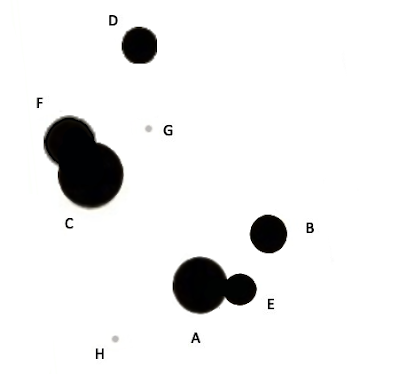
Star map of the Trapezium to clarify the positions of the partially resolved stars

The six stars of the trapezium are labelled A through F. The positions of two other much fainter stars are shown as G and H.

Negative image

The stars of the Trapezium pose an interesting challenge to observers and imagers attempting to resolve them. Observers in locations such as the UK which frequently suffers from the disruptive effects of the jet stream and poor seeing, and where Orion is quite low in the sky, are less likely to be able to achieve the resolving of the component stars on an average night. More southerly locations where the jet stream is out of the way and Orion is higher in the sky are likely to facilitate the resolution of the Trapezium's component stars.


More testing of the versatility of the SV405CC

An SV405CC TEC-cooled OSC was placed at the Cassegrain focus of a motor-focus modified Skymax 127 Maksutov. The camera was fitted with a 1.25" adapter and an SVBONY IR/UV cut filter. The equipment was mounted on a Celestron AVX mount.

Click on an image to get a closer view

The Equipment used


SV405CC OSC and the Maksutov

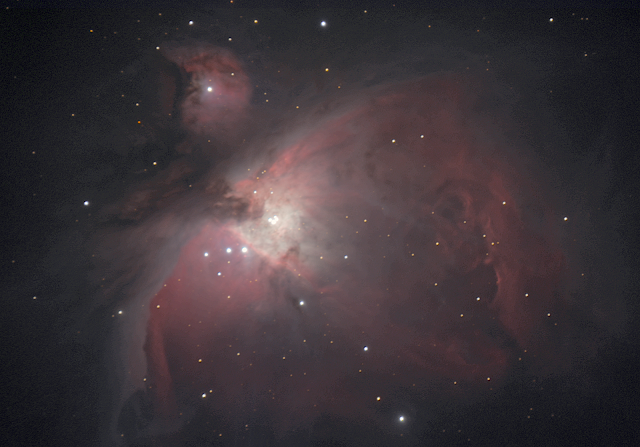
A 17" Fedora Linux laptop running AstroDMx Capture for Linux was used to capture 120 x 20s FITS  exposures of the Orion Nebula with matching dark-frames; all under an 87.6% Moon.

Screenshot of AstroDMx Capture for Linux capturing FITS images of the Orion nebula

Even with a long focal length Maksutov, the large sensor of the SV405CC is large enough to capture a large portion of M42/43.
The data were stacked in Deep Sky Stacker and Affinity Photo running in a Virtual Win 10 machine running on the Fedora laptop. The resulting images were combined and post-processed in the Gimp 2.10.30. The image was post processed to show details of the Trapezium area as well as the surrounding nebulosity.

M42/43


There is no doubt that the SV405CC performed well with the Maksutov, which is probably more suited to lunar and planetary imaging.


The equipment was aimed at the 87.6% waxing, gibbous Moon.
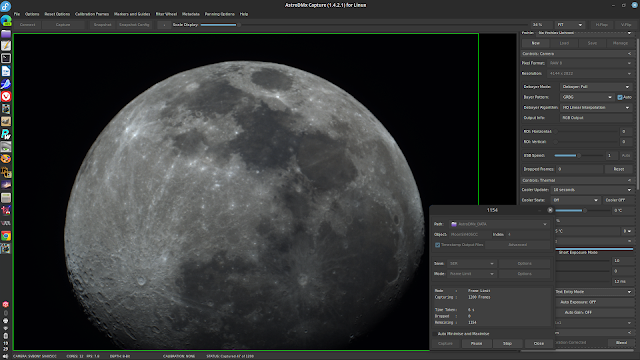
AstroDMx Capture for Linux was used to capture two, overlapping, 1200-frame SER files of the Moon at maximum resolution (4144 x 2822).

Screenshots of AstroDMx Capture for Linux capturing lunar SER files


The best 95% of the frames in the SER files were stacked in Autostakkert!, Stitched into a 2 panel mosaic using Microsoft ICE, wavelet processed in Registax 6 and post processed in the Gimp 2.10.30.

Click on the image and click again to get a much closer view.
Give the large image chance to load.

87.6% waxing, gibbous Moon

Once again, the SV405CC OSC proved to be a very capable, sensitive and versatile camera.

Tuesday, 8 March 2022

Testing the versatility of the SV405CC OSC camera

An SV405CC OSC was placed at the Cassegrain focus of a Skymax 127 Maksutov that was modified for motor focus. The scope was mounted on a Celestron AVX GOTO mount

AstroDMx Capture for Windows was used to capture a 1200-frame SER file of the 25.3%, waxing, crescent Moon. The SV405CC was un-cooled for this experiment.

Click on an image to get a closer view

Screenshot of AstroDMx Capture for Windows capturing the lunar SER file.


The sensor is large enough to capture the whole lunar crescent.

The best 95% of the frames in the SER file were stacked in Autostakkert! and post-processed in the Gimp 2.10.

Final image of the 25.3% waxing, crescent Moon


Full Size image

Give the image time to load.

Scroll to see the whole image


The SV405CC OSC is clearly a capable lunar imager in addition to its primary role as a deep sky imager.